
Making Tools to Ease Manufacturing and Testing
Explore the first reusable tool Kavrous is using to make manufacturing and testing more reliable and consistent.
Making manufacturing tools can be a game changer when it comes to consistently bringing up products that you sell to customers. These tools can help you test for the same things every time, understand board failures more quickly, and provide a path toward more automated testing. These things are important when you are small. Any process you can affordably make more efficient gives you time to put back into your business.
Here at Kavrous Technologies, we realize that one of our most time-consuming tasks is testing boards after manufacturing. Manufacturing itself still takes the most time in our operation, but improvements there will come when we have the product volume to justify the expense. For now, one area where we can improve efficiency is board testing. Right now, it's pretty archaic.
Where board testing slows us down
Testing involves busting out the multimeter to check for shorts between pins, between power supplies, and between power supplies and pins. These tests are very slow and manual. After testing for shorts, it's time to connect the board and make sure it can be programmed, if it's a microcontroller-based product, or verify that we can communicate with the device via I2C, SPI, or another interface. One thing we can't fully verify right now is whether a board can toggle every output and produce a valid, measurable signal on each one.
Introducing the BREAD Prog Multiprogrammer
To solve these main issues, we set out to create a multi-programming tool. One board we have that is particularly useful for this is the BREAD 2040. It's our breadboard-friendly RP2040 board that we launched as Oak Development Technologies back in 2021. BREAD 2040 has been one of our most versatile boards, providing a great starting point for trying out new products. It exposes all the pins we could ever need, and as an RP2040-based board, it can use PIO USB. PIO USB is valuable to us here because a lot of the development boards we make have native USB support. ESP32-S3, RP2040, and even upcoming Kavrous drone products have native USB support.
We want to tackle all these problems across all these platforms, so here it is: the Kavrous BREAD Prog Multiprogrammer. It's a fairly basic board with socket headers for the BREAD 2040, a TPS22917 load switch for controlling the PIO USB port's power, a USB Type-C connector dedicated to power, and a double row of header pins to connect the board to all kinds of test beds.
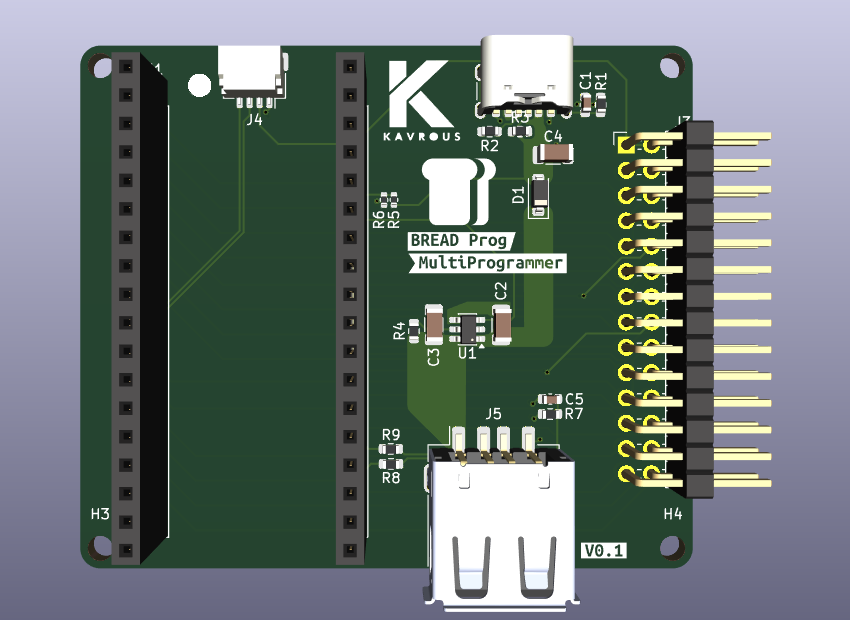
An open-source design
This multiprogrammer will be open source, so you can use it to make your own test stand or as an easy way to do tons of other fun projects. We've shared the schematic below. This is an early schematic, so it might change before the final version is ready.
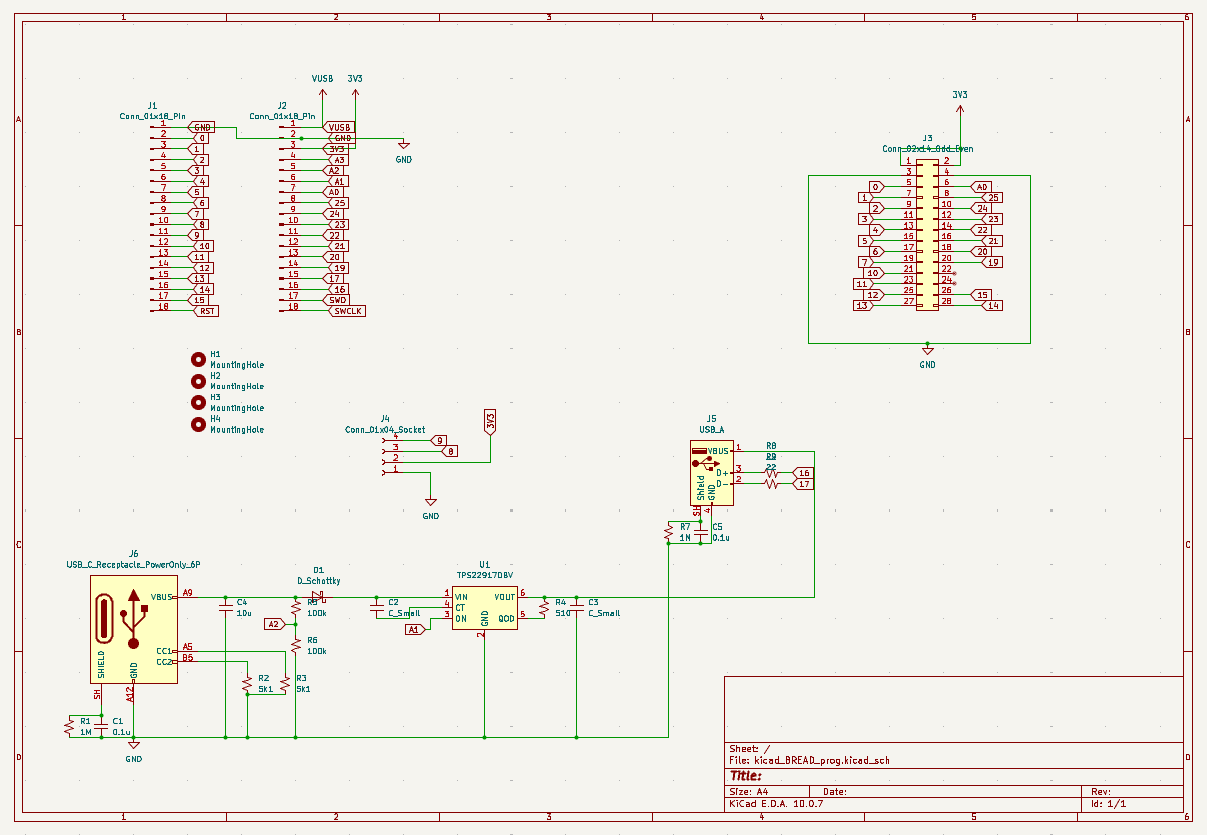
Schematic description
The BREAD 2040 plugs into two 18-pin socket headers, J1 and J2. These expose its input/output pins, power connections, reset, and serial wire debug connections. The double-row, 28-pin header J3 brings out pins 0 through 15 and 19 through 25, along with A0, 3.3-volt power, and ground, for connection to a test bed. The separate four-pin socket J4 connects pins 8 and 9, 3.3-volt power, and ground.
The power-only USB Type-C connector J6 supplies the TPS22917 load switch U1. Pin A3 controls the switch's enable input, and the switch's output supplies power to the USB Type-A connector J5. The USB data lines connect to pins 16 and 17 through 22-ohm series resistors. This arrangement lets the BREAD 2040 control power to a connected USB device and communicate with it using PIO USB.
What's next
BREAD Prog will help Kavrous move into the future, speeding up manufacturing and development as we create new and exciting products, especially our drone products.
Seth Kerr
Founder and CEO
Kavrous Technologies